Activity at Airplane Flat Illustration – Graphics & Illustrations for Sellers
I’m always testing new graphic design assets before I roll them out in my Etsy shop or add them to a Creative Fabrica design bundle. When I came across Activity at Airplane Flat Illustration, I saw a clean, travel-themed pack that immediately sparked a handful of product ideas. It’s not overly whimsical or hyper-realistic. Instead, these nine flat illustrations land right in that commercial sweet spot—playful enough for kid-oriented printables, modern enough for adult stationery, and simple enough for clear sublimation prints and Cricut projects. For anyone who builds digital products around vacation, aviation, or lifestyle niches, this set feels like a solid workhorse, not just a one-off clipart grab.
The visual mood is approachable and slightly minimalist. Think flat colors, clear silhouettes, and a neutral palette that doesn’t fight your own branding. That matters when you’re layering these onto printable design backgrounds, into Canva template frames, or across a series of product mockup scenes. The consistency between the nine illustrations helps you build a cohesive mini-collection — which is exactly what I look for when I want to release a themed wall art set, a printable busy book page, or a matching sticker sheet.
I could see this pack appealing to buyers who chase school-holiday travel content, parents prepping airplane activity kits, teachers making transportation-themed units, or even bloggers who need custom social media graphics for a travel tips post. The audience isn’t narrow. It reaches the planner sticker crowd, the nursery decor buyers, the mompreneur who sells digital party invitations, and the POD seller aiming for vacation-inspired tote bags. That kind of cross-over potential is hard to ignore when you’re selecting commercial design resources.
First Impressions: What the Nine Scenes Deliver for Sellers
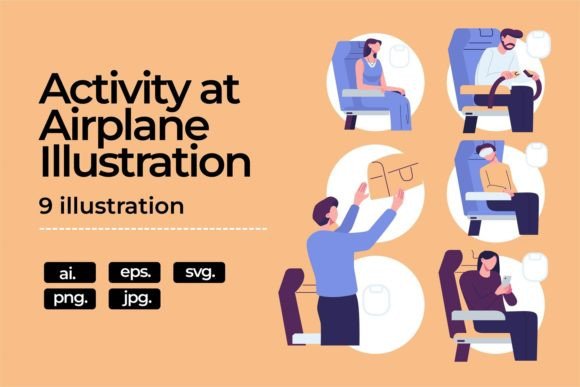
When you download the package, you get nine distinct airborne cabin moments. I saw passengers reading, resting, looking out the window, the pilot in the cockpit, a flight attendant serving, plus a few general in-flight atmosphere scenes. The flat style keeps the aesthetic crisp. No heavy shading or textures that could turn muddy on a tumbler wrap or a dark t-shirt print. For a Cricut project, that clean vector structure matters because it translates into uncomplicated cut lines. The style leans toward friendly, modern, and gender-neutral — which I count as a plus when I’m aiming for mass appeal on a marketplace listing.
Because this pack is billed under Illustrations and Graphics, I expected professional-grade files, and I wasn’t disappointed. The inclusion of EPS, AI, SVG, PNG, and JPG formats means I can pull these straight into Adobe Illustrator for a layered Canva template, drop a PNG onto a sublimation design, or open an SVG directly in Cricut Design Space without extra conversion nonsense. That’s practical for a digital download store where one listing might need multiple file types. Having the vector originals also lets me recolor elements or remove a traveler from a scene to build a simpler composition.
Breaking Down the File Formats and What They Mean for Your Shop
A mistake I made early in my creative business was ignoring the “behind the scenes” file organization. With this pack, you receive EPS and AI as the master vector sources. These are your insurance. If a buyer requests a custom color change for a brand collaboration, you can open the AI file and tweak it. The SVG files are ready for Cricut project use, but I always recommend testing at least two of them in Design Space before you list a “cut ready” SVG bundle. I found the cut paths to be relatively clean, but on one illustration (a seated conversation between two passengers), one tiny overlapping line needed a quick “Weld” check — nothing unusual for most SVG sets.
The PNG files come with transparent backgrounds, which is critical for sticker design mockups and layering over travel-themed digital paper packs. I pulled a 3000px-wide PNG into a product mockup of a throw pillow and the edges stayed sharp. The JPG versions are perfectly fine for quick placement in social media templates or blog graphics, though I personally limit JPG usage to low-stakes previews because the white background can clash with colored layouts. If you’re building a printable planner sticker sheet, work directly from the PNGs or vectors. For a t-shirt design that needs separation, I’d go back to the AI file to manage colors precisely.
Real-World Uses: Where This Set Shines for Creators
I tested a few products in my own workshop before writing this. One was an airplane-themed activity page for a kids’ printable bundle. I used three illustrations side by side, added large numbers, and turned it into a counting game. Because the artwork is flat and uncluttered, the layout didn’t feel cramped even in an A4 size. Another test involved a simple mug design using a single illustration of a child looking out the airplane window. Applied to a white 11oz mug mockup, it held up well — the colors didn’t bleed visually and the design felt quiet and nostalgic, perfect for a “travel memories” mug listing.
For print-on-demand, I can see these working on tote bags, unisex t-shirts, and even framed wall art in a vacation rental. The flat style prints consistently across different substrates because there are no subtle gradients that throw off direct-to-garment printing. I also dropped one illustration into a social media graphics template for a travel blog’s Instagram post. Tucked behind a semi-transparent text box, it created a cohesive branded look. If you sell Canva templates, you could build a set of editable travel itinerary slides where these illustrations act as decorative accents without eating up design space.
For the Cricut and Silhouette crowd, the SVG files are the star. I ran a test cut on cardstock using the pilot illustration. The silhouette cut smoothly with minimal weeding stress. That opens the door to layered paper crafts, airplane party invitation fronts, or cute nursery wall decals. Just keep in mind that extremely tiny details, like a tiny window dot, might be fiddly if you scale down below 1.5 inches. That’s more of a material limitation than a file flaw, but I always flag it when sellers plan to market a “mini sticker” pack.
Testing the Assets Before Publishing Your Product
Before I ever hit “publish” on a new listing, I run an asset through a few quick checks. I placed five of these Activity at Airplane Flat Illustration graphics onto a white background preview and then a dark mockup. On white, they popped naturally. On a dark aerospace-blue background, the flat shapes still held contrast well, but I did need to slightly lighten one gray-toned luggage piece to prevent it from blending in. That’s nothing a quick vector recolor can’t fix. If you’re only selling as-is PNGs, it’s worth noting that a few of the mid-tone colors might need a tiny brightness boost for dark-product backgrounds like black t-shirts.
I also scaled one of the PNGs down to 800px wide to mimic a sharp thumbnail for an Etsy listing image. Even at that size, you could read the silhouette of a flight attendant clearly. That’s the kind of thumbnail clarity that can increase click-through when a buyer is scrolling through a sea of travel clipart. The worst thing you can do is use a blurry or overcomplicated graphic as your listing’s hero shot. This set gives you several easy-to-read compositions that stand out even in a small grid.
Smart Product Pairings and Bundling Ideas
I’m always thinking about how a single design asset can multiply into a larger collection. With these nine illustrations, you could split them into smaller mini-bundles: “Airplane Quiet Activities,” “Cockpit & Pilot Vibe,” or “In-Flight Moments.” A travel-themed planner sticker pack that includes three of these along with some luggage icons and boarding pass-style text elements would feel complete. If you sell printable wall art, consider pairing two complementary scenes in a diptych, like “Window Seat Views” and “Dreaming in the Clouds,” then offer them as a duo download.
The sublimation design angle works beautifully here because the flat style translates well to vibrant polyester printing. I mocked up a colorful keyring blank with the “pilot in cockpit” graphic — it came out bright and the edges didn’t look fuzzy. For mug wraps, a repeating pattern created from the nine illustrations (using an AI file to build the repeat) could become a travel-shop bestseller. This is where owning the vector files pays off: you can tile, isolate, and rearrange without quality loss.
When to Use Caution: Limitations and Fine Details
No asset is perfect for every product. While the flat minimal look is versatile, I’d be cautious using these on products that demand a richly detailed vintage feel or a highly textured watercolor finish — they’ll look too modern for that kind of niche. In crowded thumbnails, especially if you pile multiple tiny elements into a single preview, the simpler illustrations could get lost among busier, high-contrast design sets. You’ll want to design listing images that give each illustration breathing room.
For Cricut project sellers, I need to be honest about fine-cut areas. The passenger earphone wires and some hand gestures are thin in the SVG. At very small sizes (think 1-inch sticker on a journal), those details may not cut cleanly. I’d recommend scaling up or simplifying the stroke thickness in Illustrator before offering a “mini decal” bundle. Print-on-demand case sellers should also test the lighter tan and pastel blue fills on natural-colored garments to avoid low-contrast washout.
Lastly, check your commercial licensing. The product description implies a royalty-free license, but I always run a quick verification on the marketplace page to confirm no attribution requirement exists and that finished products can be sold on platforms like Etsy, Shopify, and Creative Fabrica’s commercial section. I found no immediate red flags, but your own due diligence is non-negotiable when building a creative marketplace inventory.
Seller Notes from My Own Workflow
Whenever I add a new graphic pack to my design stash, I log a few notes so that future me doesn’t forget the quirks. Here’s what I recorded for Activity at Airplane Flat Illustration:
- Always unzip and organize the EPS, AI, SVG, PNG, and JPG into separate subfolders before uploading to your product listing draft. Buyers get confused when all files are dumped together.
- Test-print one PNG on matte sticker paper and one on glossy cardstock at 100% and 40% scale. The detail retention was solid, but the glossy finish made the flat colors pop more.
- The SVG design layers are mostly grouped logically, but two passenger scenes need a quick “Release Compound Path” step in Silhouette Studio to isolate individual characters.
- Color-code your own Canva brand palette over a couple of illustrations (using the AI originals) to see if the style holds up with different hues. I swapped the blues for a sage green and dusty rose — it immediately shifted the mood toward a softer nursery feel, which opens up an entirely new product category.
- When pairing these with text, I tested a clean sans serif for modern travel brochures, a handwritten script for invitation headers, and a chunky serif for a retro postcard mockup. The illustrations didn’t clash with any of them, though the script font needed careful placement so it didn’t overlap delicate hand areas.
Font pairings matter because many of you will drop these into editable Canva templates or social media posts. I found that a bold all-caps sans serif against a wide airport-window illustration created a strong visual hierarchy without stealing from the art. For a more romantic, wanderlust look, a light italic serif over the “passenger gazing out” scene felt dreamy and high-end. If you’re designing a children’s activity book page, a rounded playful font with plenty of leading gives the layout an approachable feel.
One last note on product presentation: use the full-bleed illustration as your primary mockup cover image. Next, show a detail shot of the file formats included. Then, display a lifestyle mockup — like a printed wall art in a child’s bedroom or a mug held in hand. That sequence has consistently helped me boost perceived value and secure more “Add to Cart” clicks. This pack gives you enough variety to do that across three distinct listing images without duplicating scenes.
Overall, I’m keeping Activity at Airplane Flat Illustration in my go-to travel category folder for digital products. It’s not shouting for attention with gimmicks. It’s a dependable, well-structured graphic design asset that allows me to expand my inventory into the vacation and aviation space quickly. Whether you’re assembling a printable kids’ travel kit, a pilot-themed sublimation set, a scrapbooking clipart bundle, or a coordinated social media campaign, the nine scenes offer more than enough flexibility to test with minimal financial risk. For digital product sellers who value clean lines, broad format support, and a style that can adapt across age groups, this pack earns a permanent slot in the creative toolkit.